

What looks like a simple login step—enter username, password, and 2FA—actually sits at the intersection of custody models, compliance rules, and practical risk management. For a US-based trader deciding whether to sign in and trade on OKX, the technical mechanics of authentication and the higher-order choices about where private keys live and what permissions you grant are what determine safety, flexibility, and future costs. This article follows a single case: a US retail trader who wants to re-open an OKX account, use both the exchange’s central services and its Web3 wallet, and move between spot, margin, and derivatives markets responsibly.
We’ll walk through the exact sign-in flows and wallet models you’ll encounter, unpack the security and regulatory trade-offs, surface common failure modes (and how to avoid them), and finish with a short decision framework that helps you pick the right login-and-custody posture for your trading objectives.
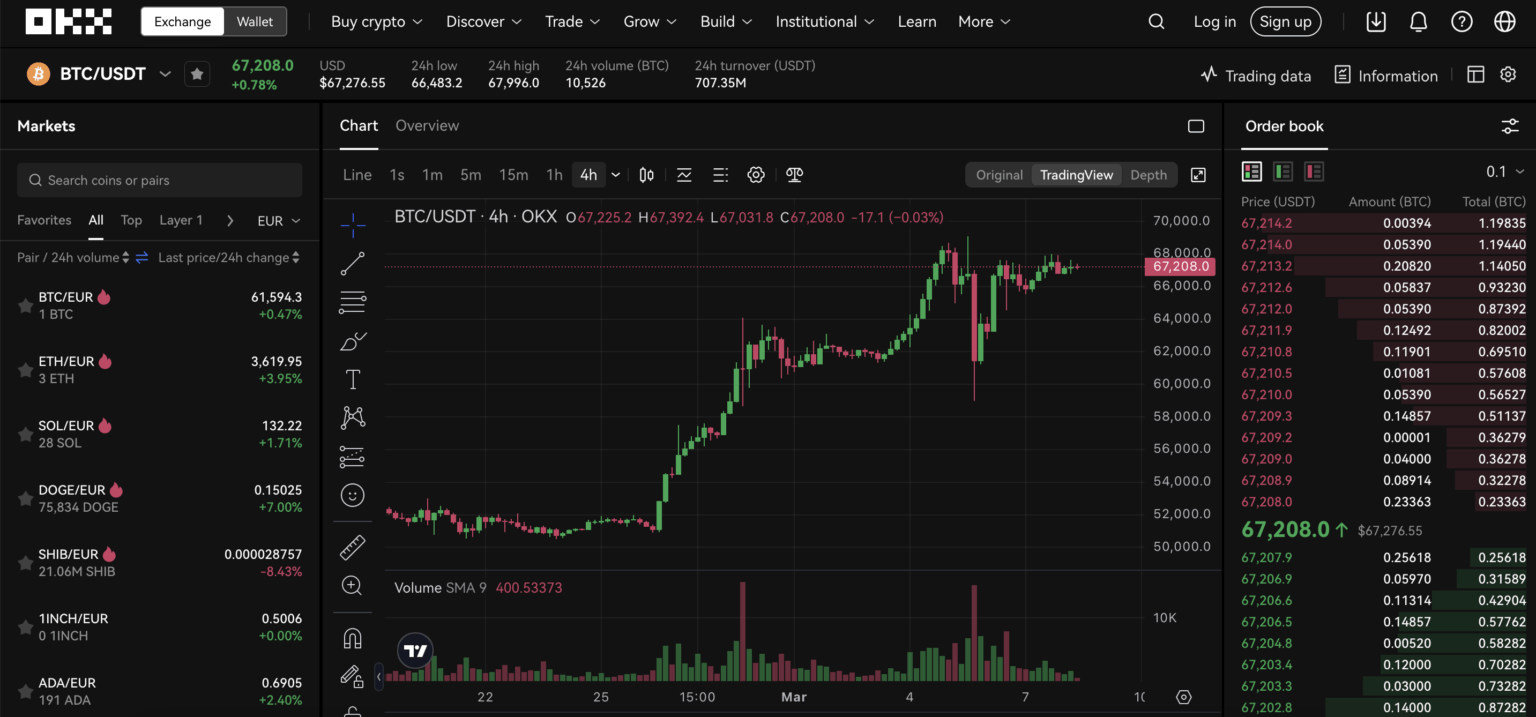
Case: a US trader returning to OKX — step-by-step sign-in and initial decisions
The returning trader needs three things before a trade: 1) an authenticated OKX account with KYC completed; 2) a clear custody choice (custodial on the exchange or self-custodial in the OKX Web3 wallet); 3) safety controls enabled (2FA, withdrawal whitelist, hardware wallet if using self-custody). The practical sign-in path begins at the web login page or the mobile app where the platform supports biometric login. If your account was inactive or restricted, the KYC requirement means you will have to re-submit identity documents and complete a facial liveness check. That’s routine but important: for US users, KYC is non-optional and ties to withdrawal limits and product access (for example, derivatives or margin).
One small operational tip: during reactivation, keep your phone used for 2FA and a scanned copy of an ID handy. OKX mandates Two-Factor Authentication (2FA) and uses AI-based threat detection; if the exchange flags suspicious login behavior it may require additional verification steps that delay access. If you’ve lost previous 2FA access, the restoration process is slower and more intrusive—so plan for recovery time in volatile markets.
Mechanics and trade-offs: custodial account vs. OKX Web3 wallet
Mechanism: when you “sign in” to OKX as a centralized account, the exchange holds custody of the private keys for assets on the exchange ledger; withdrawals require exchange approvals and multi-signature cold storage is the backstop for most user funds. By contrast, the OKX Web3 wallet is non-custodial: you hold your seed phrase and can connect to DApps or manage funds without the exchange’s custodial controls. Each model has distinct trade-offs.
Trade-offs: custody gives convenience and access to features like spot, margin, and derivatives (including up to 125x leverage on some perpetuals and options for advanced traders). It also benefits from the exchange’s cold-storage practices (over 95% of assets reportedly offline in multi-sig cold wallets) and on-chain Proof of Reserves transparency. The cost is counterparty risk: while the exchange secures assets, you do not control keys, and access depends on platform operations, KYC status, and withdrawal procedures.
Self-custody hands you unilateral control—reduced counterparty risk and full Web3 interoperability (hardware wallet integrations, direct DApp connections, cross-chain swaps through the DEX aggregator). The cost is responsibility: if you lose your seed phrase, access is permanently lost; smart contract interactions introduce external attack surfaces; and moving between self-custody and the exchange requires careful bridging, which can incur fees and slippage.
Logging in and layering security: practical sequence
Begin with the web or app sign-in and confirm multi-factor authentication. Prefer an authenticator app over SMS when possible—SMS is better than nothing but vulnerable to SIM-swap attacks. If you enable biometric login on mobile, treat it as a convenience layer, not a sole control: combine biometrics with device-level encryption and a strong OS passcode.
Next, add withdrawal protections: whitelist addresses for stablecoins or frequently used hot wallets, set daily withdrawal limits, and enable mandatory 2FA for withdrawals. For traders using derivatives or margin, consider segregating funds: keep collateral on the exchange for active positions but store long-term holdings in a hardware-protected non-custodial wallet. This reduces attack surface for large, idle balances while leaving capital available for active strategies.
How trading functions affect sign-in posture and operational risk
Products change what authentication and custody choices matter. Spot trading and staking require custody but lower real-time operational burden. Margin and derivatives amplify both gains and risks: leverage magnifies not only market moves but also operational mistakes (a late account lock can translate into liquidation). For high-frequency derivatives users, low-latency authenticated sessions are important—but so is a recovery plan if the exchange forcibly freezes accounts for suspicious activity. That’s why active US traders often maintain both: a custodial balance sized only for active trades and a separate self-custodial wallet for reserve funds and DeFi positions.
One non-obvious point: the platform’s DEX aggregator and cross-chain support make on-chain transfers easier, but the routing that optimizes for price can still suffer slippage or bridge delays. When logging in to execute cross-chain swaps, check estimated gas and slippage tolerances carefully—those parameters matter more than whether you used the web or app to log in.
Limits, failure modes, and how to prepare
Limit: KYC ties access to identity. If regulatory pressure or compliance reviews require additional documentation, withdrawals may be delayed. That is a non-technical risk but materially affects liquidity planning. Recent, routine delistings (for example, the exchange recently removed several low-volume spot pairs) are a reminder that not every token you hold will remain tradable on the platform indefinitely; delistings force you to decide whether to withdraw, swap, or accept constrained liquidity.
Failure modes: lost 2FA, compromised email, phishing sites, or mis-signed transactions from a connected Web3 wallet. Each has a different remedy: 2FA loss typically requires identity re-verification with the exchange; phishing requires quick change of credentials and contacting support; self-custody errors are often irreversible. A practical mitigation is to maintain an offline ledger of recovery steps, a hardware wallet for large holdings, and a small “operational” hot wallet limited by whitelist rules and low withdrawal caps.
Decision framework: three user archetypes and recommended posture
1) Active derivatives trader: prioritize fast, secure access to the exchange, use custodial funds for margin, enforce strict 2FA and withdrawal whitelists, and keep collateral sized to expected peak exposure. Maintain a hardware-secured reserve offline for long-term holdings.
2) Spot/staking investor who uses DeFi occasionally: split funds—use the Web3 wallet for DeFi and staking with hardware integration and auto-compounding if desired; keep a custodial account for quick spot trades and fiat rails but limit on-exchange balances.
3) Web3-native user who values control: default to the non-custodial OKX wallet, integrate a hardware wallet, accept the trade-offs (no exchange-mediated recovery), and use the exchange only to access fiat on-ramps or specific centralized products when necessary.
What to watch next (signals and conditional scenarios)
Monitor three signals. First, regulatory developments in the US that change KYC or product availability can suddenly alter withdrawal or trading access—if regulation tightens, expect richer identity checks and possible product restrictions. Second, liquidity changes: exchanges regularly delist low-volume pairs; keep an eye on delisting notices and move illiquid tokens before spreads widen. Third, Proof of Reserves disclosures and custody audits: sustained transparency reduces some counterparty uncertainty, but it is not a substitute for personal risk decisions.
Conditional scenario: if OKX increases restrictions on certain derivatives for US users, active traders using high leverage would need to shift strategies to lower-leverage products or use alternative venues—both choices change the required sign-in and operational posture (more frequent withdrawals, different margin maintenance checks, or alternative custody models).
FAQ
How do I choose between the OKX custodial account and the OKX Web3 wallet?
Choose based on the combination of convenience and control you need. If you require quick access to margin and derivatives, a custodial account is necessary. If you prioritize owning private keys and interacting directly with DeFi, use the Web3 wallet with hardware integration. Practically, many users split funds: custodial for active trading, self-custodial for reserves.
What should I do if my 2FA device is lost while I have open positions?
Immediately contact OKX support and prepare ID documentation for account recovery. If possible, move non-essential funds to a secure self-custodial wallet via a device that still has access. For active leveraged positions, expect delays; plan for this risk as part of position-sizing to avoid forced liquidations during an account lock.
Does OKX’s Proof of Reserves mean my funds are always safe?
Proof of Reserves provides on-chain evidence of backing but does not eliminate operational risks: access controls, platform outages, regulatory holds, and personal security mistakes still matter. Treat PoR as one transparency signal, not an absolute guarantee.
Can I use a hardware wallet with both OKX’s exchange features and the Web3 wallet?
Yes. The Web3 wallet supports Ledger and Trezor integrations for self-custody. However, hardware wallets do not change the fact that exchange-held ledger balances remain custodial; hardware keys only secure your non-custodial seed-managed addresses.
If you want a short, practical checklist for getting back into an OKX account and moving safely between exchange and Web3 wallets, this page summarizes the exact login flows and recovery links you’ll use in practice: okx. Use it as an operational complement to the strategic framework above: authenticate, enable 2FA, segment funds, and plan for recovery before you need it.
Closing takeaway: signing in is not just a technical act—it signals a custody choice. The best traders treat login and wallet decisions as a tactical layer of risk management, adjusting their posture as products, liquidity, and regulatory signals change. Be deliberate, document your recovery plan, and size your on-exchange exposure to the smallest amount compatible with your trading edge.